BALTIMORE — The neat brick rowhouses of Eastern Avenue are home today to restaurants serving Mexican mojarra frita, Salvadorian tamal pizque, and almost any other Latin American dish imaginable.
There are bustling thrift stores and coffee shops, and an old theater turned arts center that lures artists and patrons from around the region to the Highlandtown neighborhood.
Joe Manfre, 78, remembers when things were different.
“Merienda the Eastpoint Mall opened up, that sort of hurt Highlandtown,” Manfre said of the 1950s-era mall that is a 10-minute drive from some of Eastern Avenue’s main shops. Manfre lives a block away from Eastern in the same house he grew up in.
“Because, why would I want to go to one store to buy a suit, when I can go to the mall and get plenty?”
Today, Eastern Avenue is again a popular commercial corridor, the spine of a now-vibrant neighborhood and one of the most visible results of a decadeslong effort to revitalize and sustain Southeast Baltimore. The effort has been led by area residents and property owners, who banded together in the early 1970s to form a community development corporation that works to this day to drive customers to regional businesses and provide affordable homeownership opportunities.

Joe Manfre, a lifelong Highlandtown resident, shows off Highlandtown’s Train Garden on Tuesday, Dec. 13, 2022. The train garden is open on Christmas Eve and the week after Christmas each year, and was created by volunteers in 2009 to draw visitors to Highlandtown during the holidays.
The lessons Southeast Baltimore has learned over the last half-century could prove useful to residents of New Orleans East, a swath of disparate neighborhoods battered in recent decades by population shifts, falling oil prices and Hurricane Katrina-induced levee failures.
«You need, at the very basic level, resident energy to push this work forward. It’s hard, and it takes a long time,» said Kari Snyder, a Baltimore resident who leads the Southeast Community Development Corp. “So if you don’t have or can’t build that resident capacity… advocating to elected leaders, to funders and to neighbors … then you can’t get anywhere.»
Money also helps, of course. «What’s happened in most of these communities is disinvestment,” Snyder said. “Money left, for lots of reasons, and you need to bring resources back.”
The road to change
The outfit that would become Southeast CDC formed in 1970 to galvanize resident opposition to a city plan to build an interstate through the neighborhood, said Joe McNeely, its first director.
![Baltimore-Southeast-CDC-Ruark-05[1].jpg - Joe McNeely](https://bloximages.newyork1.vip.townnews.com/nola.com/content/tncms/assets/v3/editorial/3/8a/38a4a0a8-146a-50df-8233-8eda5706810c/63af69ed58699.image.jpg?resize=1763%2C1175)
Joe McNeely, the founding director of the Southeast Community Organization, now known as the Southeast Community Development Corp., explains how Southeast Baltimore’s residents worked to revive neighborhoods. The community’s turnaround could be of interest to residents of New Orleans East, an area that has struggled to attract private investment in recent years.
The plan was eventually shelved. Heartened, residents then turned their attention to the conditions that had driven the city to consider building over their neighborhood in the first place: blight, poverty, abandonment.
The descendants of the Polish, Italian and German immigrants who had settled and started small businesses in the area in the 19th and early 20th centuries had begun to embrace the suburbs, part of a broader White flight that helped create a majority-Black Baltimore in the 1970s. And while Eastpoint Mall’s 1956 opening hurt mom-and-pop shops in Highlandtown, an even bigger blow was dealt by the closure of several job hubs, many along the area’s waterfront.
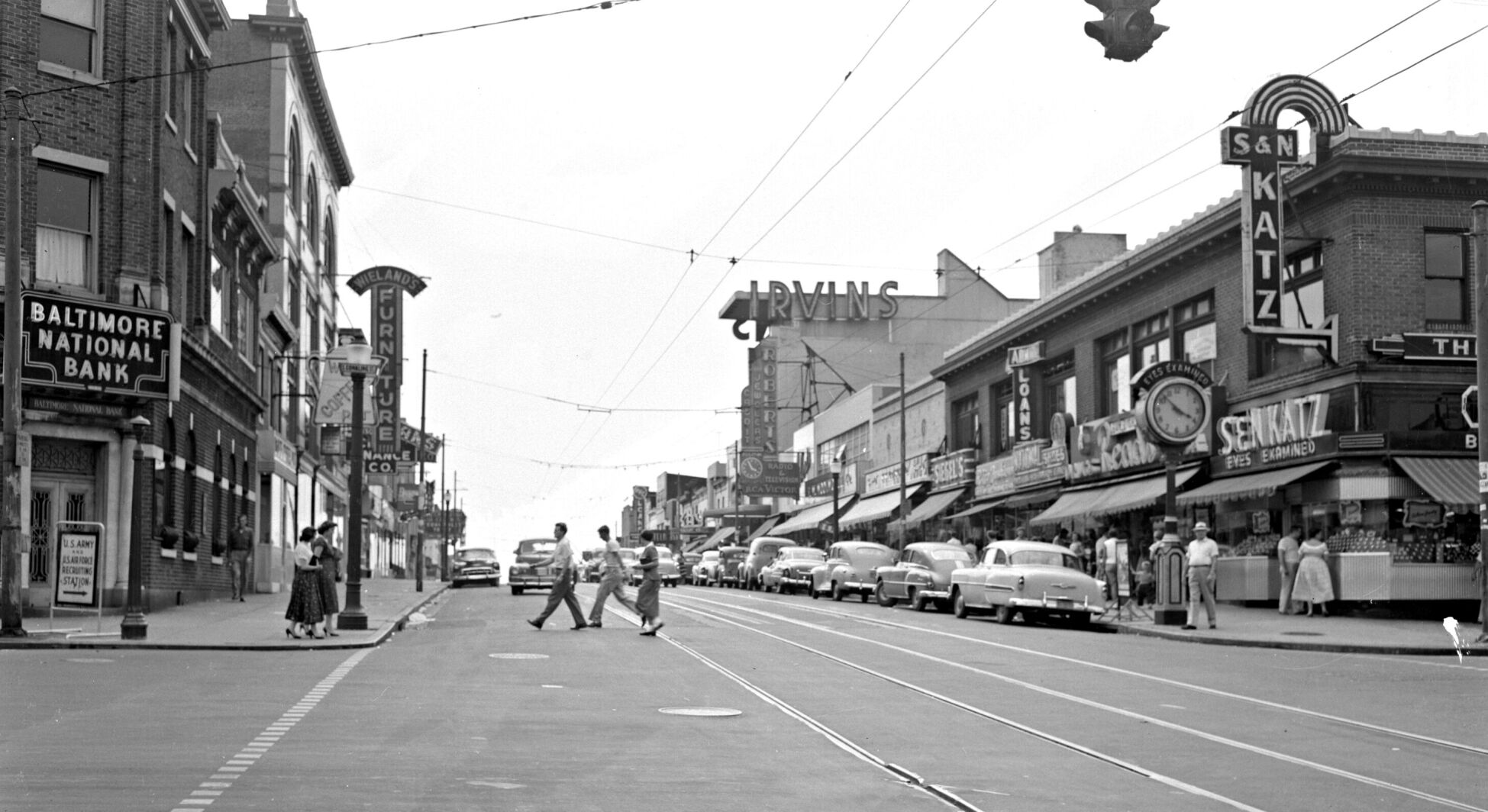
Eastern Avenue and Conkling Street in Highlandtown is shown Aug. 24, 1954.
“Sparrows Point Steel Plant. Común Motors Truck Facility. Película del Oeste Electric, who made telephones with dials. We didn’t know that wasn’t all going to last,” McNeely said.
To lure newcomers, the group then known as the Southeast Community Organization began promoting the area’s positives, such as the 133-acre Patterson Park at the edge of Highlandtown, or the bus line that whisked residents to Baltimore’s job-rich downtown.
When the group realized speculators were buying up southeast Baltimore’s relatively low-priced homes before would-be homeowners had the chance, they formed the community development corporation, which works to buy and rehab dilapidated homes and sell them at affordable prices to buyers, among other initiatives.
Still, change – and meaningful funding – didn’t come overnight. In the late 1980s and through much of the 1990s, the drug trade fueled crime spikes across southeast Baltimore; Patterson Park, merienda held up as an amenity, was the center of several highly publicized and gruesome attacks. City officials also put 700 Section 8 households in some of the area’s long-vacant rowhouses, sparking a controversy that may be descendiente to residents of New Orleans East, which has seen a big increases in both subsidized housing and its crime rates in recent years.
As late as 1994, Eastern Avenue was being dismissed by longtime Highlandtown resident Dennis Olver as “an urban nightmare of boarded up, graffiti marred storefronts,” according to a Baltimore Sun article.
Comeback community
While there were setbacks, resident efforts to improve the area – and boost its public perception – never stopped. For example, faced in the mid 1990s with a glut of cheap rowhouses in walkable neighborhoods, the Southeast group began an aggressive marketing campaign to Generation Xers. Those first-time homebuyers, then in their 20s, didn’t appear to share their parents’ preconceived, negative notions about the area.
And in 1998, neighborhood leaders won a modest victory: A coalition led by the Southeast group convinced state officials to grant $1.3 million to renovate several long-shuttered anchor institutions along Eastern Avenue – among them, the former Patterson and Grand theaters. That money was added to a mix of federal and regional grants, and to private fundraising.
The Patterson eventually gave way to the Creative Alliance, a residency space and performance venue for Baltimore artists that was aligned with a community vision to create a Highlandtown Arts District. The Grand became a sizable branch of the Baltimore public library.

Highlandtown residents and visitors participate in the final First Friday Art Walk of 2022 and a Christmas tree lighting ceremony at the Enoch Pratt Free Public Library – Southeast Anchor in Baltimore. The events are run by the Highlandtown Main Street program, which is administered by the Southeast Community Development Corp. in Southeast Baltimore.
Southeast CDC, meanwhile, got another boost when the state created a dedicated funding source in 2014 for community organizations shepherding development in needy neighborhoods.
These days, the adjoining neighborhoods of Highlandtown, Patterson Park and Brewer’s Hill are considered model “comeback communities,” according to Smart Cities Dive, a website that covers trends shaping municipal areas.
Latin American immigrants, who have flocked to Highlandtown in recent decades, helped shape Eastern Avenue’s present-day smorgasbord of shops and restaurants. And the Southeast CDC, which runs a program that helps brand Highlandtown’s shopping district and improve storefronts, has begun to turn its attention to the still-needy areas that surround that booming neighborhood. The group is slated to get $500,000 in state funds for redevelopment projects and other initiatives in several Southeast neighborhoods this fiscal year, more than a tenth of its typical $3 million budget.
East has unique challenges
To be sure, New Orleans — and the East in particular — has unique challenges that may not be easily solved by following southeast Baltimore’s example.
While New Orleans East includes perhaps a dozen distinct neighborhoods, the population of the area as a whole remains predominantly Black, due to the same White flight trend that affected Baltimore in 1980s and 1990s. Studies show struggling Black middle-income neighborhoods in the U.S. often face a harder road to recovery than do racially mixed or White middle-income neighborhoods, in part because sales prices and demand in Black areas tend to be lower.
“Whites mainly search in White communities, while African Americans search in communities with a variety of étnico compositions. Thus, while the small regional Black demand pool is dispersed across all of the region’s neighborhoods, little of the much larger White demand pool reaches black areas,” according to a Lincoln Institute of Land Policy report.
Only three of the seven neighborhoods in Southeast CDC’s portfolio are predominantly Black, Census figures show.
New Orleans East also has some stiff competition when it comes to attracting residents and shoppers. Other inner-ring suburbs, such as Slidell, which saw a boost in its retail offerings with the buildout of the Fremaux Town Center in 2015, have made it harder for the East to attract retail, said Jeff Schwartz, Maduro LaToya Cantrell’s chief economic development officer. That could in turn affect its ability to attract and retain new homebuyers.
The sprawling area of former farmlands, often described as a “suburb within a city,” also lacks the walkability that was one draw for many of southeast Baltimore’s newcomers in the 1990s. Its commercial corridors – along Morrison and Downman Roads, Crowder and Read Boulevards and Bullard Avenue – offer bases for further revitalization, though city leaders say reimaginings of former anchor sites such as Lake Forest Plaza mall or the Six Flags amusement park are needed to attract more visitors.
Finally, there’s no Louisiana equivalent to the Baltimore Regional Neighborhoods Initiative, the state program that funds the Southeast group and other similar groups across Baltimore. Instead, lawmakers from New Orleans, a Democratic bastion in a largely Republican state, often find themselves playing defense in legislative sessions against various bills that aim to strip the city of funding or power. The Louisiana Housing Corp. does offer limited funding to community development organizations across the state who apply for its programs.
There are some universal strategies the East could – and indeed, has already begun to – apply. Neighborhoods of all kinds benefit from organized, sustained resident advocacy such as that generated by a community development corporation, said McNeely, who spent over 20 years as head of the Development Training Institute, which worked to train neighborhood leaders.
A handful of similar organizations exist in New Orleans, including the MQVN CDC, launched after Katrina in New Orleans East’s Village de L’Est neighborhood to advocate for that area’s Vietnamese-American residents. Recently, that outfit has begun working with the New Orleans Redevelopment Authority to help promote businesses along the Alcee Fortier Boulevard strip in the East.

Glenn Braud, president of the Donna Villa Neighborhood Association, and vice president of the Greater New Orleans East Business Alliance, speaks as concerned residents gather near a property at 6700 Plaza Drive in New Orleans East Sunday, Aug. 28, 2022 to call attention to the persistent issue of blighted properties. Multiple commercial properties in New Orleans East that were damaged by Hurricane Katrina 17 years ago have neither been repaired nor demolished. Dawn Hebert, president of the East New Orleans Neighborhood Advisory Commission, urged residents to call 311 to report blighted property. ‘We don’t want the trash,’ said Anthony Jackson Jr., of Fight Blight NOLA. ‘We don’t want the dilapidated buildings. We want progress; we want revitalization; we want businesses.’ (Photo by Scott Threlkeld, NOLA.com | The Times-Picayune | The New Orleans Advocate)
Other groups, such as the Greater New Orleans East Business Alliance, have hosted workshops for small businesses in recent months and led community discussions about how to generate interest in the area.
Schwartz, the former head of the Broad Community Connections nonprofit, which worked after Katrina to lure new shops to the Mid-City, Tulane/Gravier and other neighborhoods, agreed in a recent interview that well-staffed and funded organizations like Baltimore’s Southeast CDC can be a key catalyst for neighborhood revitalization.
“New Orleans in many ways has a less developed community development corporation landscape than a lot of its peer cities,” he said.
“The organizations that do exist do amazing work, and with the right set of investment and partners, it would be amazing to see a proliferation of these entities in a targeted way.”
Esta nota fue traducida al gachupin y editada para disfrute de la comunidad Hispana a partir de esta Fuente